Fatma Aliye Topuz
Pioneering nineteenth-century Ottoman novelist, philosopher, essayist, and
humanitarian who championed women's rights and education

Fatma Aliye, pioneering female novelist and thinker
Fatma Aliye was born on 26 October 1862 into the elite Istanbulite household of statesman and historian Ahmed Cevdet and his wife, Adviye Rabia. Growing up in a household with a reformist (albeit religious) father, she developed an early curiosity for intellectual pursuits.
Despite the opening of girls' secondary schools (rüșdiye) in 1858-59, formal schooling was still considered a male pursuit. Aliye had no choice but to pursue knowledge through alternative means: at a young age, she developed a relationship with her father's coffee-brewer, Süleyman Ağa, who conversed with her on myriad topics.
Because Ahmed Cevdet served as governor, the family relocated to Aleppo from 1866 to 1868. There, Aliye's passion for education only grew; she secretly listened in on her brother Ali Sedat's lessons with his in-house teacher, Lofçalı Ibrahim Şevki Efendi. By doing so, she taught herself to read.
To her parents' surprise, Aliye became proficient in reading by the age of six. Her father's scribe began teaching her to write, introducing her to French, an act that would change the trajectory of Aliye's life.
Realising her natural talent, her brother's tutor, Hoca Mustafa Efendi, arranged private lessons for Aliye. Like her brother, she was educated at home in subjects such as history, astronomy, geography, and religion.
When the family returned to Istanbul, Aliye began lessons in philosophy and ethics. Her interest in French pushed her to ask her tutor, Süleyman Efendi, for resources on the French alphabet. When he procured them for her, Aliye retreated to her room, where she secretly began learning to read and write in French.
One day, while hiding away in her room, Aliye's father stumbled upon her reading one of his french books. Amazed by her ability, he arranged for Ilyas Matar Efendi to give her lessons in the language for the next three years. Her abilities even exceeded those of one of the formally educated teachers who, having just graduated from the Women's Teaching Academy, was likely shocked to find that the young girl knew more than she did about astronomy, geology, and cosmography.
Aliye's interest in knowledge introduced her to the Ottoman, French and English literary scene; apart from reading newspapers and magazines(that incidentally introduced her to the ideas of British naturalist Charles Darwin), she was a prolific reader of stories, both historical epics like Battal Gazi, and more modern dramatic works like Ahmet Mithat's Hasan Mellah.
Aliye's intellectual pursuits and interest in European languages and culture continued well into her teenage years, encouraged by her French-English tutor Mademoiselle Alpha. Despite her passion for knowledge, Aliye understood that her fate was to mirror that of the women around her. At age seventeen, she was married to Faik Bey (1854-1928), one of the confidantes of Sultan Abdulhamid II. Aliye's life was to change drastically following this union.

Fatma Aliye's childhood was one surrounded by the elites of the post-Tanzimat era
Marital life ended all of Aliye's intellectual pursuits. Faik Bey, like many of his contemporaries, was suspicious of European novels, considering them as harbingers of immorality and Westernisation. Deeming them inappropriate reads for such a "virtuous" woman, he warned his wife not to read them. When his warnings fell on deaf ears, he attempted to rip up her novels, officially "banning" Aliye from reading fanciful stories.
In 1880, Fatma Aliye gave birth to her daughter Hatice, followed by Ayse in 1884. During this time, she continued to follow women's journals and read her beloved novels in secret. Her translation of sections of Eugene Sue's Les Sept Peches Capitaux from French to Ottoman Turkish was also completed during this time.
Around 1887, following her husband Faik's transferral to a post in the central Anatolian city of Konya, leaving Fatma alone with her two daughters. During the eleven months that the couple were separated, Aliye developed a mystery illness considered fatal by medical professionals. On his return, Faik's worldview had completely changed; together with Aliye, the couple began to enjoy French novels.

Fatma Aliye's Father, statesman Ahmed Cevdet Pasha
Interestingly, Fatma Aliye often showed almost filial piety toward her husband's authority. Her translation of George Ohnet's Volonté, according to her own account, occurred when she floated the proposition by her husband, which he reluctantly accepted. By 1890, Volonte had been published as Meram, translated by "a woman", instead of "Fatma Aliye".
Her experiences during this trying period of her marriage likely influenced her first work with Ahmet Mithat. Jointly authored and published under the pseudonym "A Woman", Hayal ve Hakikat (1892) focused on women's reading and appropriate reading materials within the context of "hysteria", the common Hamidian-era belief that overstimulation of the "fragile" female brain could cause psychological illness.
Amidst all of the troubles she had experienced, Fatma also experienced familial disapproval and speculation that she had not authored her novels. Upon the revelation of her identity as a writer, Ali Sedat showed disapproval of his sister's intellectual pursuits. Many attributed the works to his or Ahmet Mithat's doing, a claim that greatly upset the writer. In one of his letters to Aliye, Ahmet Mithat, ever her greatest supporter, ironically wondered if her brother would claim that her father Ahmed Cevdet (by then deceased) had risen from the grave to help Aliye write her famous 'History of Muslim Women'.

A first edition copy of Refet (1897)
The author continued on her journey, writing throughout the 1890s; in 1892, her first novel, Muhazarat, followed by Refet (1898), Udi (1899), Enin (1910), Levaih-i Hayat, originally serialised in the newspaper Hanimlara Mahsus Gazete (Newspaper for Ladies) around 1900.
Her essays are particularly important as early examples of women's historiography and anthological works. The Biographies of Philosophers (1900) and Victory in Kosovo / Defeat in Ankara: An Important Era of the Ottoman History (1915) showed Aliye's intellectual versaility in writing both fiction and non-fiction, and secular, intellectual prose in addition to religious-centred ones.
In addition to gaining local praise, Fatma Aliye received international attention. In 1893, her work was exhibited at the Chicago World's Fair, although she herself did not attend. Her work was also translated into French and Arabic, showing that her stories, like Udi, had an international audience.
Perhaps less known is Aliye's contributions to the press. Between 1895 and 1908, she worked as a writer for Hanimlara Mahsus Gazete, a conservative women's magazine aimed at educating women and preparing them for their ultimate roles as wives and mothers of future generations. Within both her works and her articles, Aliye expressed a desire for women to be in charge of their own destinies: her characters were economically independent, educated, and often made their own marital choices, even if that meant rejection of suitors.
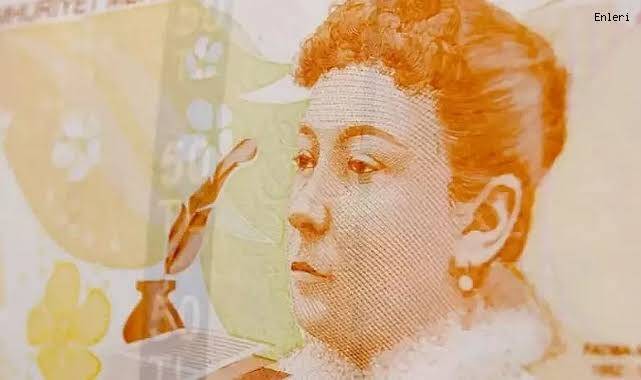
Fatma Aliye was placed on the 50 Lira banknote in Turkiye (Jan 1, 2009)
Following the 1908 Constitutional Revolution (Meşrutiyet), Aliye's literary efforts dwindled. She published a lone biographical-historical work on her father (Ahmet Cevdet Pasha and His Time, 1914) to ward off criticisms of the censorship and ineffective state administration that occurred during the pre-Meşrutiyet period.
In the media, too, Aliye was overshadowed by even more revolutionary voices, including her sister Emine Semiye and nationalist figures like author Halide Edip.
Falling largely into obscurity by the 1920s, Fatma Aliye's life was rocked by scandals and tragedies. In 1926, her youngest daughter, Ismet, went to live in a Christian convent in France, apparently becoming a Roman Catholic nun. This destroyed the conservative and religious Fatma Aliye, who had spent much of her life writing about and defending Islam and Muslim women. Albeit travelling to France several times, Aliye could not locate her daughter's whereabouts.
Two years later, her husband passed away. Not much is known about how she spent her final years, except that she was not in good health and was in dire financial straits. She passed away on the 13th of July, 1936, almost two years after adopting the surname Topuz for her family.