Ahmed Cevdet Pasha
Prominent nineteenth-century historian, statesman, jurist, and
educator who influenced the formation of a modern civil legal code.

Cevdet Pasha, a decorated statesman
Source: Osman Nuri and Ahmet Refik, Abdülhamid Sani ve Devr-i Saltanati (1910), 745.
Ahmed Cevdet was born in the provincial town of Lovech, modern-day Bulgaria, on the 22nd of March, 1822. His father, Ismail Ağa, was a local administrator with ties to the religious elite of the town, including the town’s mufti (religious scholar), Hafiz Omer Efendi, who tutored Ahmed in the Arabic language. His early education was thus thoroughly dominated by theology and religious scholarship
A promising student, Ahmed travelled to Istanbul in 1839, taking further studies in theology, along with more secular subjects like astronomy, mathematics, geology and literature. His studies particularly focussed on Arabic and Persian literature, the former especially being the lingua franca of the Muslim world and of Islamic ilim studies.
A turn in his studies occurred at the Hendesehane, the Imperial Military Engineering School, where he was introduced to the scientific study of history, along with European language like French, and International law.
This period of Ahmed’s education coincided with the Tanzimat Era, a time of modernistic and secular reform instituted by the Ottoman state that would have wide-reaching socio-political effects. Much of the reforms instituted by Sultan Abdulmecid’s Gulhane Edict (1839) sought to establish equality among the millets, reform the military and beauracracy along Western European lines, and to adopt European technologies, political systems, and even social institutions like theatres. Ahmed was one of the many Tanzimat figures who had to balance the conservative religious tradition with the innovations of the nineteenth century.
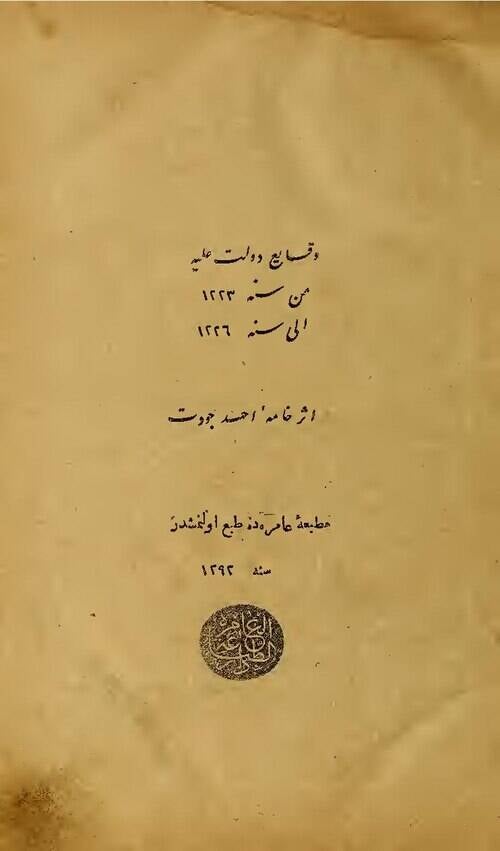
The first print of the Tarih-i Cevdet, a multi-volume history that spans the period of 1774 to 1825.
After becoming a tutor to Grand Vizier Mustafa Resid Pasha and his children, Ahmed became more intertwined in the elite beauracratic circles that pushed for reform. In 1850-51, Ahmed, also known by now as Cevdet, a moniker meaning “virtue” and “perfection”, was appointed by the grand vizier as the director of a teacher training college. Albeit still connected to the ulema class, Ahmed Cevdet had entered a new bureaucratic role as the Council on Education’s chief scribe, cementing his role in secularising Ottoman law and education.
Throughout the 1850s-1860s, he entered a string of jobs, ranging from being commissioned to write a history of Ottoman civilisation to being a state chronicler. His magnum opus, the multi-volume Tarih-i Cevdet, was a history of the empire from 1774 to 1826. Cevdet’s training in European historical scholarship emerged throughout the work; not only was it a description of events, but it offered a deeper analysis of the causes and effects; in essence, it was an early attempt by an Ottoman historian to use the historical method to understand the recent decline of the empire.
Religious scholarship continued to play an important role in Cevdet’s life, especially in the late 1860s, when he chaired the commission that penned the Ottoman civil code, the Mecelle-i Ahkâm-ı Adliyye (ca. 1869-1876). Historically, the Ottoman state had used two parallel legal systems; The Sharia, or Islamic law, and the Kanun, the secular code encompassing a range of issues not addressed by the Sharia. The Mecelle aimed to codify civil Islamic Hanafi jurisprudence into laws that could be applied by a modern legal and court system and understood by individuals outside the ulema.
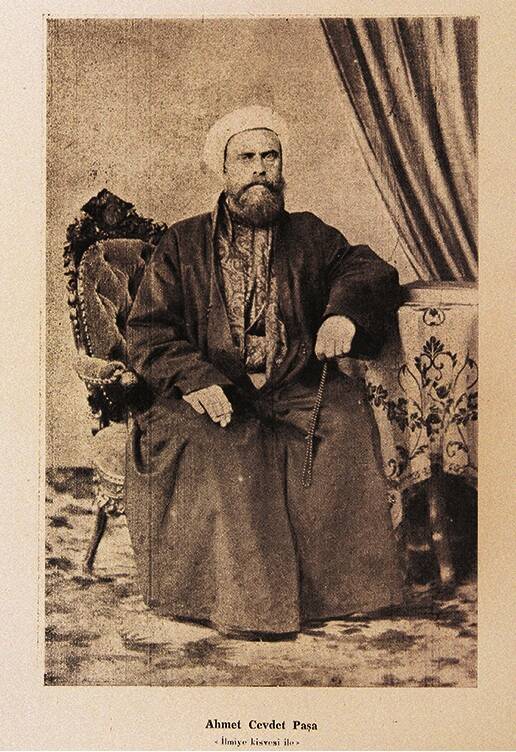
Cevdet Pasha in the garb of the ilmiye religious scholars
The creation of the Mecelle hit significant roadblocks due to the polarisation of Ottoman intellectual political thought during this time. The different strands of thought in regards to the extent of legal modernisation led to a rift between those who thought that European civil codes, such as the French Code Napoleon, shoul have been imported to the Ottoman context. Ahmed Cevdet opposed the total adoption of European codes, instead arguing for a synthesis of European thought with Islamic tradition.
Cevdet’s nuanced character is especially evident in his role in advancing educational reform. Despite his deep involvement in Islamic scholarship, the statesman helped develop the Ministry of Public Education (Maarif-i Umumiye Nezareti). Unlike the religious madrasas, new institutions under this system incorporated geography, science, languages, administrative studies and history into their curricula.
Aside from his Tarih, Cevdet wrote important works in the field of political memoir (see Tezakir), history of Islam (see Kısas-ı Enbiyâ; Tevârîh-i Hulefâ), administrative studies (see Ma’ruzat), and language (see Belâgat-ı Osmâniyye).
Interestingly, Cevdet’s dual identity as an Ottoman steeped in the traditional religious sciences, albeit with a modernising tendency, was also reflected in his daughters: Fatma Aliye, who would go on to become the earliest female novelist, and Emine Semiye, who advanced the Turkish feminist cause.
He died in 1895, at the age of 73, marking the end of an illustrious, multi-faceted career that had a lasting impact on the development of the late Ottoman Empire and modern Turkey.