Sultan Abdülmecid I
The thirty-first sultan of the Ottoman Empire, modernizer, and pioneer of the Tanzimat era who reshaped imperial law, diplomacy, and civil society.

Sultan Abdülmecid I, sovereign reformer of the Ottoman realm
Born in 1823 to Sultan Mahmud II and his consort Bezmialem Sultan, Abdülmecid was raised in a modernistic milieu, receiving training in literature, classical music and European languages like French. This likely encouraged his predilection for European modes of living later in life.
Abdulmecid’s youthful days were cut short when his father Mahmud died in 1839, leaving the seventeen-year-old Abdulmecid to take his place as sultan. Abdulmecid was thrown into state administration at a time when the empire was in turmoil. The critical province of Egypt, an important agricultural and economic source for the Ottomans, was under the de facto rule of an Ottoman governor-turned-khedive (hereditary ruler), Muhammad Ali; The Ottoman navy had just had a crushing defeat against Egypt, which usurped their forces. Serbia had pushed for further independence in the early 1830s; The Ottomans were heavily reliant on British and French efforts to protect their empire against both encroachments from Russia and the ambitions of figures like Muhammad Ali of Egypt. The teenage sultan had, to his dismay, inherited an empire on the brink of collapse.
On top of that, the European powers supporting the Ottomans expected the Ottomans to institute reform programs to modernise their empire and secure the rights of non-Muslims within the empire, something they could now demand. Foreign Minister Mustafa Resid Pasha, with the permission of the Sultan, drafted a template of a ferman (imperial edict) setting a number of infrastructural and political changes to be implemented. This edict, called the Gülhane Hatt-i Hümayun (Gülhane Edict), is better known as the Tanzimat Edict (Edict of Reorganisation). On the 3rd of November, 1839, in the presence of the leaders of various millets (ethno-religious communities) and foreign ambassadors, Resid Pasha read the document, beginning the Tanzimat period.
The Tanzimat essentially guaranteed equal property and life rights for all Ottoman subjects, regardless of which millet they belonged to. Among other things, it also introduced a system of fair trial, ending some of the arbitrariness that had plagued the justice system. Encouraged by the Ottomans’ efforts, Great Britain brokered the Treaty of Balta Liman a trade agreement that formed an unspoken agreement on the part of the British to provide military assistance. In 1840, the Convention of London was signed between the Ottomans and the European powers of Britain, Prussia, Austria and Russia. The original terms of the treaty included the offer of Egyptian territories and Sudan to Muhammad Ali’s government, and the return of Syrian and Greek territories to the Ottomans. The Egyptians, however, did not accept these clauses, leading to an escalation of the conflict; British and Russian forces defeated the forces of Mehmet Ali—son of the khedive—leading the French to join their cause, and further pushing the support-less Muhammad Ali to accept the treaty.

The declaration of the Imperial Edict of Gülhane in 1839, ushering in the Tanzimat reforms.
However, Abdulmecid’s problems were just beginning. A series of international crises plagued his rule in the 1840s. In 1845, various communities in Syria and Lebanon erupted into civil conflict between Maronite Christians and the Druze people, no doubt influenced by Ottoman, British and French efforts to form administrative districts that did not reflect local power balances and interests. The Ottomans sent foreign minister Şekib Efendi to Beirut to broker peace, which quelled discontent only temporarily. A few years later, Austria requested the extradition of Hungarian nationalists seeking refuge in Turkey, which Abdulmecit refused to do, increasing his positive public image.
The encroachment of European powers into Western Asia was a theme that lasted throughout Abdulmecit’s reign. In 1850, Louis Napoleon of France, distracting from political issues at home, championed the right to protect Catholics in Palestine. Three years earlier, minor conflict had broken out between Catholic monks and priests, and their Orthodox counterparts. Russia, as self-proclaimed protector of Orthodox Christians, wanted increased power to intervene in issues, which the Ottomans refused. The issue escalated, from Russia’s occupation of the Ottoman borderlands, Moldavia and Wallachia. On October 4th, 1853, the Ottomans declared war on Russia, dragging Britain and France, who feared a strengthening Russian Empire, into the Crimean War. The conflict ended with the signing of the Treaty of Paris (March 30, 1856), a humiliating defeat for Russia.
Importantly, Article IX of the treaty mentioned the Islahat Edict, which had been drafted only a few weeks earlier. Partially in order to appease the European powers, partially to preserve Ottoman control over its own internal affairs and citizenry, Abdulmecit proclaimed a new edict. Called the Islahat fermanı, this “Reform Edict”, drafted with the help of the Grand Vizier, Sheyh-ul-Islam, and British and French ambassadors, granted all Ottoman citizens— regardless of religious belief—equality in public offices and education. It also broke with centuries of Ottoman tradition by abolishing the jizya, the traditional tax levy paid by non-Muslims in exchange for state protection and maintenance.
The reach of the Tanzimat reforms stretched through almost every aspect of Ottoman life in the mid-eighteenth century. Abdulmecid, having a close knowledge of Western European innovations, began by instituting these in his own country; the first private Turkish newspaper, the Cerîde-i Havâdis, was formed—with governmental support—in 1840 by Winston Churchill. In 1856, The sultan also authorized contracted a British company to build the first Anatolian rail line between Izmir and Aydin, although it would not be completed until Abdulaziz’s reign.

More in line with European customs, Abdulmecit increased his public visibility; He attended the meetings of the Council of Ministers, and travelled around Anatolia to hear the grievances of Ottoman citizens. In 1844, for instance, he travelled to the provinces of Bursa, Gelibolu and Izmit, and two years later, around Rumelia.
During Abdulmecid’s rule, governance of the empire underwent significant changes, a mix of the sultan’s own personal views and foreign influence. The Meclis-i Vukela, a decision-making cabinet of ministers formed during the rule of Mahmud II, was consolidated into a pillar of Ottoman governance. The cabinet, comprised of semi-independent ministers, including a minister of finance, education, treasury, public security, alongside the Valide Sultan’s steward and certain religious ministers, worked in an advisory capacity. Nizamiye courts separate from the Sharia courts were established and placed under the jurisdiction of the Ministry of Justice, rather than within the power of the religious class.
Education reform was also one of the most prominent ways in which social change was enacted. Primary education, hitherto up to the discretion of families, was compulsory and free-of-charge. This was, however, largely built on gender lines, with the first girls’ secondary school only opening in 1858. Technical institutes also became an important aspect of Abdulmecid’s reforms. The growing need for specialised training led to the opening of a School of Medicine/Midwifery (1842) and Forestry (1859). In 1847, the Dârülmuallimîn, a teacher’s academy, had been established to accommodate the increasing number of these educational institutes being established.
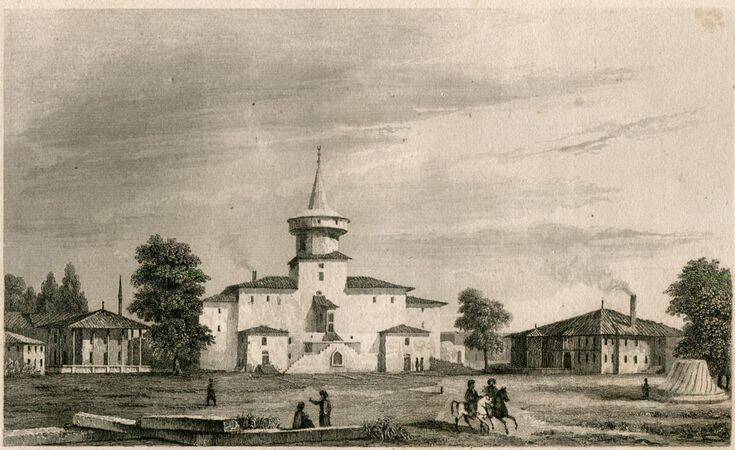
Engraving of the Eski Saray (Old Palace), 1840
Abdulmecid’s reign, saw the Ottomans in some of the most dire financial conditions that they had ever confronted. Economically impacted by the political turmoil of successive wars, particularly the Crimean War, the Ottomans were forced to take out foreign loans in 1854, 1855, 1858 and 1860. Some of the reforms even mitigated financial strain. The system of tax-farming, a century-old tradiiton, was reformed as central government officials began to supervise the collection of taxes, a reform later reversed because of its hasty and ineffective implementation. By the late 1850s, the situation had reached a peak, with the total loans from Beyoglu’s moneylenders exceeding eighty million gold liras.
Despite the reformative milieu, Abdulmecit also set out to reinstate roles that increased his authority. The grand vizeriate had an immense turnover during his reign, with twenty-two grand viziers changing in twenty years. Towards the end of the 1850s, Abdulmecid’s reign saw a deadly mix of political instability, financial difficulty, foreign intervention and growing discontent amongst conservative figures. Grand Vizier Ali Pasha’s criticism of the general situation in October 1859 was evidently shared by other sections of society. A month earlier, an attempted coup, dubbed the Kuleli Incident, unveiled the deep-rooted dissatisfaction with the perceived degradation of religious legal traditions and general political instability. The Fedailer Cemiyeti (Society of Martyrs), a secret society composed of soldiers and ulema figures like Sheikh Ahmed Efendi, aimed to replace Abdulmecid with his brother Abdulaziz. When member Hasan Pasha betrayed their plans, the instigators were tried and exiled.
In October 1859, pressures grew as Britain, France, Austria, Prussia, and Russia sent a note to the Ottoman government, claiming that the reforms outlined in the 1856 Reform Edict had not been European involvement grew more evident in 1860 as conflicts erupted in Lebanon, fueled by tensions between the Druze and Maronite communities. Before the situation was resolved, additional disturbances erupted in Damascus, leading to the deaths of the Dutch and American consuls. In response, the European powers heightened their pressure on the Sublime Porte, and France deployed troops to Beirut. Foreign minister Fuad pasha was subsequently deployed to Lebanon and imposed punishments on authority figures, including officers and administrators, who were accused of negligence. On 9 June, 1861, Lebanon was also reorganised as a sanjak, this time under the control of a non-Muslim governor (mutasarrıf).
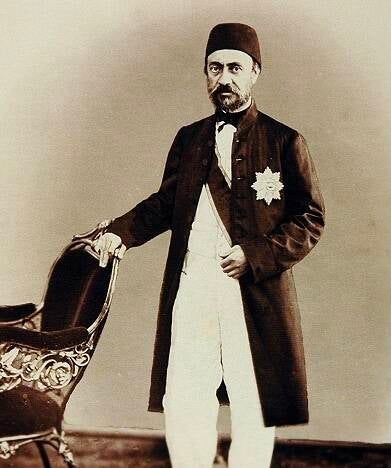
Mehmed Emin Ali, one of the major engineers of
the Islâhat Hatt-ı Hümâyûnu (Reform Edict of 1856)
These political and financial challenges coexisted with notable advancements in intellectual, cultural, and architectural fields. The Encümen-i Dâniş, established in 1850, was regarded as the first scholarly academy in the Ottoman Empire and included both Turkish and foreign scholars among its members. Numerous construction and development projects were also undertaken. Some of the funds obtained through foreign loans were used to construct palaces and pavilions. Among the principal architectural works of the period were Beykoz Pavilion (1855), Dolmabahçe Palace (1856), Küçüksu Pavilion (1857), Küçük Mecidiye Mosque (1849), and Teşvikiye Mosque (1854). During the same period, the Gureba Hospital was constructed by Bezmiâlem Valide Sultan in 1845–46, while the new Galata Bridge was also opened. Numerous fountains, mosques, dervish lodges, and other social institutions were likewise repaired or newly constructed.
Abdülmecid also had a particular interest in theatre. His enthusiasm was such that he had a theatre constructed across from Dolmabahçe Palace in 1859. His reign also coincided with an important moment in the development of modern Ottoman theatre, including İbrahim Şinasi’s Şair Evlenmesi (The Poet’s Marriage), written in 1860 and generally regarded as the first modern Turkish play.
The sultan was characterized as naturally sensitive and quick to take offense. He was also considered by some to be impulsive, evidenced by his quick dismissal of successive grand viziers whose views swayed from his. Typical of sexist historiographical traditions, he was considered “susceptible” to the influence of those he had close relationships with, including his wives and daughters. Instead, any “influence” Ottoman royal women had should be seen as part of dynastic power and shared political decision-making.
Abdülmecid’s reign came to an end after he perished from tuberculosis on 25 June 1861, at the young age of thirty-nine ended. He was ultimately laid to rest in the mausoleum of his ancestor, Sultan Selim I.